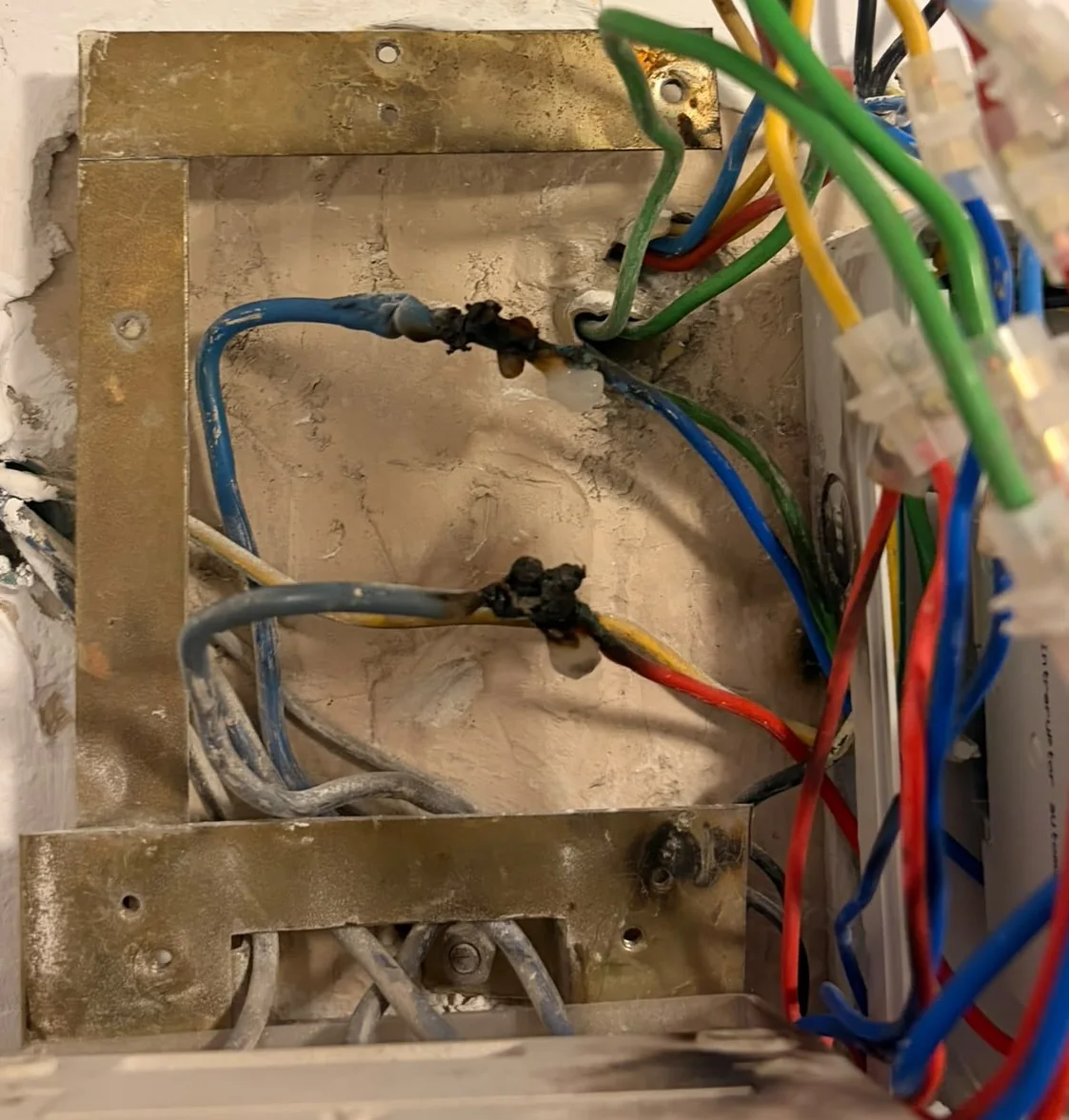
During home renovation, new copper circuits are sometimes connected to old aluminium conductors. A Cu–Al transition can be made correctly, but not with just any connector, and certainly not by twisting wires and covering them with insulating tape. A connection that “holds” today may become an overheating point after months of use.
Why is a copper–aluminium joint sensitive?
Aluminium develops a surface oxide layer that makes electrical contact harder. Copper and aluminium also behave differently when heated and cooled, and aluminium can slowly deform under contact pressure. In damp conditions, unsuitable contact between dissimilar metals can also encourage galvanic corrosion.
If contact pressure or effective contact area becomes insufficient, local resistance rises. Current produces heat, which can damage insulation, worsen the connection and encourage arcing or fire. The problem may not be immediately visible and does not necessarily involve an overload of the whole circuit.
Twisting and taping: insulation is not a safe connection
Insulating tape does not provide the pressure and mechanical stability needed for a Cu–Al joint. Covering twisted wires does not resolve material incompatibility or oxidation. Extra tape over an overheated joint hides the problem rather than fixing it.
Years of operation do not certify a connection's safety. A more powerful appliance or progressive contact degradation can reveal the fault.
An ordinary screw terminal is not automatically a Cu–Al connector
A screw or metal body does not prove compatibility. The manufacturer must specify the connector for the conductor materials, cross-sections and types used, including the transition between them. The permitted number of conductors per terminal matters just as much.
Dedicated solutions include transition connectors and bimetallic products, but selection must follow the datasheet. Not all spring terminals accept aluminium either. WAGO, for example, lists specific series and conditions for certain aluminium conductors; this is not blanket approval for every model. Use contact paste only where required or permitted by the manufacturer: it does not make an unsuitable terminal compatible.
Tightening screws: neither by feel nor as hard as possible
For screw terminals, the torque specified for the model and conductor is essential. Insufficient tightening may leave an unstable contact; excessive tightening can damage the conductor or terminal. There is no universal value for every terminal block.
Use the correct tool and, where the documentation specifies torque, an appropriate torque-controlled tool. If the terminal or conductor has thermal damage, simply tightening it further is not an adequate repair.
Periodic inspection does not mean retightening every terminal
Connections belong in installation inspections. Intervals and methods depend on equipment documentation, operating conditions and previous findings. Some systems require rechecking or retightening under certain conditions; others do not. We do not recommend “tighten every screw a little more” or work on an energised installation.
Inspection includes heating marks, damaged insulation, corrosion and mechanical connection condition. Thermography performed under suitable conditions by competent personnel can help identify hot spots; it does not replace compatibility and installation checks.
Why might the circuit breaker not trip?
A resistive contact can heat up without current exceeding the overcurrent protection threshold. Residual-current protection does not automatically detect every such fault either. Distribution board protection does not justify keeping a degraded joint.
What if you notice a burning smell or melting?
Stop using the affected circuit and request an inspection. Disconnect power only if you can do so safely without touching damaged components. Do not open the box, touch wires or improvise a taped repair. If there is smoke or fire, move away and call 112.
Pro Connection can help identify work needed to modernise the installation. Contact us for an assessment in Bucharest and surrounding areas; travel elsewhere in Romania can be discussed for selected work.
Technical sources
- WAGO — aluminium conductor compatibility and Alu-Plus conditions
- Schneider Electric — connection degradation, tightening torque and maintenance
Instructions for one device do not automatically apply to another terminal type. This article explains risks and inspection criteria; it is not a connection installation procedure.
Comments (0)
Be the first to leave a comment.
Leave a comment
Comments are published only after approval. Your display name and message will be public; your email address stays private. Do not include sensitive data or other people's personal details.